HONORING GLORIA STEINEM
GLORIA'S RINGS
One tree. Two artists. A life written in its rings.
Two works of art made from one salvaged eucalyptus, created for Gloria Steinem's memorial at the Park Avenue Armory on November 18th, 2026.
JOIN US IN NEW YORK
See Gloria's Rings at Pier 57
Both works are on view in the Living Room at Pier 57 from November 20, 2026, through April 2027. The Living Room is a public gathering space on the ground floor of the pier's southern edge, overlooking the Hudson River and Little Island. No reservation required.
Open daily, 6 AM to 1 AM
Pier 57, 25 11th Avenue, New York, NY 10011
The story
Amy Dornbusch and Gloria’s Foundation present Gloria's Rings, an art installation at the memorial for Gloria Steinem at the Park Avenue Armory on November 18, 2026. Two artists were commissioned to make two unique artworks from a single cross section of salvaged eucalyptus.
“A tree does not grow from the top down. It grows from the bottom up, and change does the same thing.”
- Gloria Steinem
How it began
A note from Amy Dornbusch, who conceived and commissioned Gloria’s Rings in partnership with Gloria’s Foundation.
Some projects you find. This one found us.
In mid-September, my longtime art advisor, Heather Marx, forwarded me an email from Nancy Hoffman Gallery about a new film by the artist Tiffany Shlain. It was about her sculpture, Dendrofemonology: A Feminist History Tree Ring, where she distilled 50 years of women's history, then burned text into the rings of a salvaged tree with pyrography. Heather had first introduced me to Shlain’s artwork reimagining tree-ring histories back in 2023 when her work was installed for a 4-day event about women’s rights on the National Mall.
A few days later, on September 25, I flew to San Diego with my friend Jessica Kaulback and our daughters. On the plane, Jessica told me about an iconic 3,000-pound eucalyptus cross section she bought years earlier and that it was the sister cross-section to the piece Tiffany Shlain had used to create the sculpture Tree of Knowledge. For three years, something pulled her back from working on it. The timing never felt right.
Tiffany's feminist tree-ring sculptures were fresh in my mind. As was Amy Richards’ email about Gloria’s upcoming memorial and the mention of an intimate gathering Barbara Becker held in the garden of Gloria’s home following her passing, referring to Gloria’s 92 rings of life as what “now forms our heartwood” and how each of us is a growth ring expanding outward from what she left behind. Jessica worked for a decade under the name Heartwood, immortalizing the lifespan of trees through art. Now, she was beginning to work on the sister slab of the same exact tree that Tiffany, the artist of Dendrofemonology, had used for one of her sculptures. The connections were undeniable.
As a philanthropist, I saw a chance to bring their work together in support of Gloria’s Foundation. What Gloria did best was bring remarkable women together to build something none of them could build alone. What if we did exactly that, to honor her?
Jessica would carve the slab face to pull a print from the tree cross section first. Then, Tiffany could burn her reimagined historical timeline into the same tree. Both on display at the entrance of Gloria’s memorial. Two unique works, one tree source, in honor of Gloria Steinem’s life and legacy.
With the memorial only weeks away, and Jessica agreeing to work with an extremely condensed production timeline, my wheels started spinning and didn’t stop until we had a plan. After working throughout the night to create a project plan, I proposed it to Amy Richards at Gloria's Foundation. She was all in.
These were the first of many yeses.
Jessica said right away, “We have to get Tiffany. It doesn’t work without her.” So, I called Heather Marx, and together we wrote to Tiffany: an invitation for the commission, along with a 30-page proposal of the vision of this project that she would be a key part of. She was in the middle of finishing her film Where Are We? on her feminist history tree ring and women’s rights that she had just dedicated to Gloria Steinem. The film would be premiering a week before the midterms in Texas. Even with the intense pressure of needing to finish her film and the fact that a project like this normally takes a year, she said yes without hesitation. Heather Marx said yes, too, agreeing to produce the whole thing, including moving the 3,000-pound sculpture and ten-foot triptych from California to New York.
Gloria’s Foundation became our partner in every sense, opening Gloria’s home, her history and their team to the work. I commissioned both artists and underwrote the first phase, and a circle of women donors soon joined me, twelve of us in all.
Then the work began. Jess went first. She carved the wood, deepening and amplifying every ring and crack, then used the tree itself as her printing press to pull Heartwood. Tiffany began the process of researching Gloria’s life with the support of her researcher and Amy Richards from Gloria’s Foundation. She then distilled Gloria’s life into a combination of 92 selected texts to represent her 92 years of life. Shlain drove up from the Bay Area to Jessica's studio in Truckee, with her designer and stenciler, and worked 15-hour days to burn Gloria’s words into the wood using a method called pyrography, “writing with fire.” On November 6, both artworks left on a truck for New York.
Fifty-five days, built on love for Gloria. Two artists, a producer, the Foundation and a circle of women who kept saying yes. Only a group of fearless women can pull off something like this.
What better way to honor her? Her life, told in two artistic interpretations on either side of the same tree slice, made by women side by side, the way she always worked. And because both artists chose to offer editions of their work with the proceeds going to Gloria's Foundation, it doesn't end at the memorial. Gloria's Rings kicks off a $30 million campaign to keep Gloria's home open, the gathering place she always meant it to be.

The Works
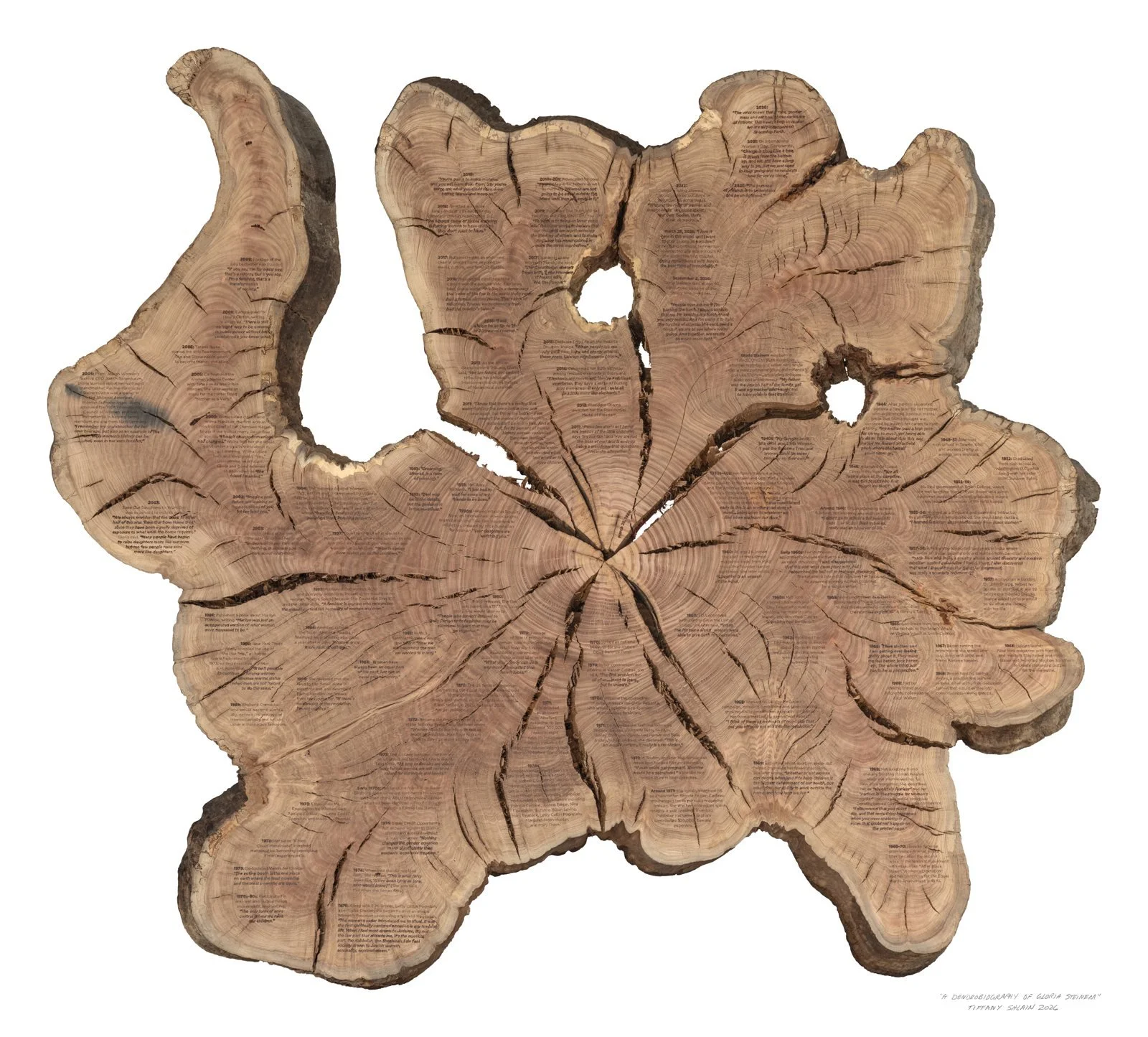
A Dendrobiography of Gloria Steinem
Tiffany Shlain
In artist Tiffany Shlain’s tree-ring timeline sculptures, she reimagines what trees have witnessed. For this work, Shlain distilled Gloria’s 92 years into 92 selected texts: facts both known and obscure, quotes both profound and funny, relationships, and key moments from the movement she helped found and grow. Each one is hand-burned into the salvaged eucalyptus by the artist using pyrography, “writing with fire.” The Sculpture is then mounted on a steel and wood base. 74½ x 86 x 12 inches, approximately 3,000 pounds.
“It is a great honor to be invited to create this sculpture paying tribute to the life and legacy of Gloria Steinem,” says artist Tiffany Shlain. “I have always deeply admired her. I’ve featured her in my films and had the chance to interview her in 2003. Distilling the brilliance, humor and profound contributions Gloria Steinem made during her 92 years was a great creative challenge. She lived such a full and amazing life. There was also a lot of serendipity in this project coming together, with incredible women making it all happen so quickly. Gloria would have loved it all.”
A Dendrobiography of Gloria Steinem grows out of Shlain’s acclaimed work Dendrofemonology: A Feminist History Tree Ring, a moveable monument that offers a timeline of humanity through a feminist lens, mapped against the concept of trees bearing witness to history. Dendrofemonology charts 50,000 years of history, distilling it into 29 points, from women holding power in ancient civilizations to the spread of patriarchy to women securing the right to vote, tracing the back-and-forth of women’s power in society. Dendrofemonology has been installed as a moveable monument on the National Mall in Washington, D.C., and in Madison Square Park in New York, and shown in museums in San Francisco, California, St. Louis, Missouri, and Seneca Falls, New York, the birthplace of women’s rights in America. It was most recently installed at the Austin Central Library where Shlain’s film Where Are We?, about the artwork and the state of women’s rights premiered a week before the midterms to bring attention to women’s rights in a state that has the most draconian laws on reproductive health. Shlain’s tree-ring timeline sculptures have tackled many different subjects including science, philosophy, and a self-portrait, and have shown at museums around the country. Shlain thinks of these tree-ring timeline sculptures as “films on wood,” telling a narrative. Many of Shlain’s titles in this sculpture series play off “dendrochronology,” the science of tree-ring dating. Dendro means “tree,” chrono means “time,” and “-ology” is “the study of.”
With A Dendrobiography of Gloria Steinem, Shlain turns the same practice toward the singular life of feminist pioneer Gloria Steinem, who also appears on Dendrofemonology. This new work tells the story of one of the movement’s defining voices as its own monumental timeline.
Heartwood
Jessica Kaulback
“Heartwood reflects the strength, wisdom, and enduring foundation Gloria Steinem built throughout her life,” says artist Jessica Kaulback. “Like the innermost core of a tree, her legacy supports all that continues to grow from it. Her spirit is resilient, and her impact lives on through the generations she has inspired.”
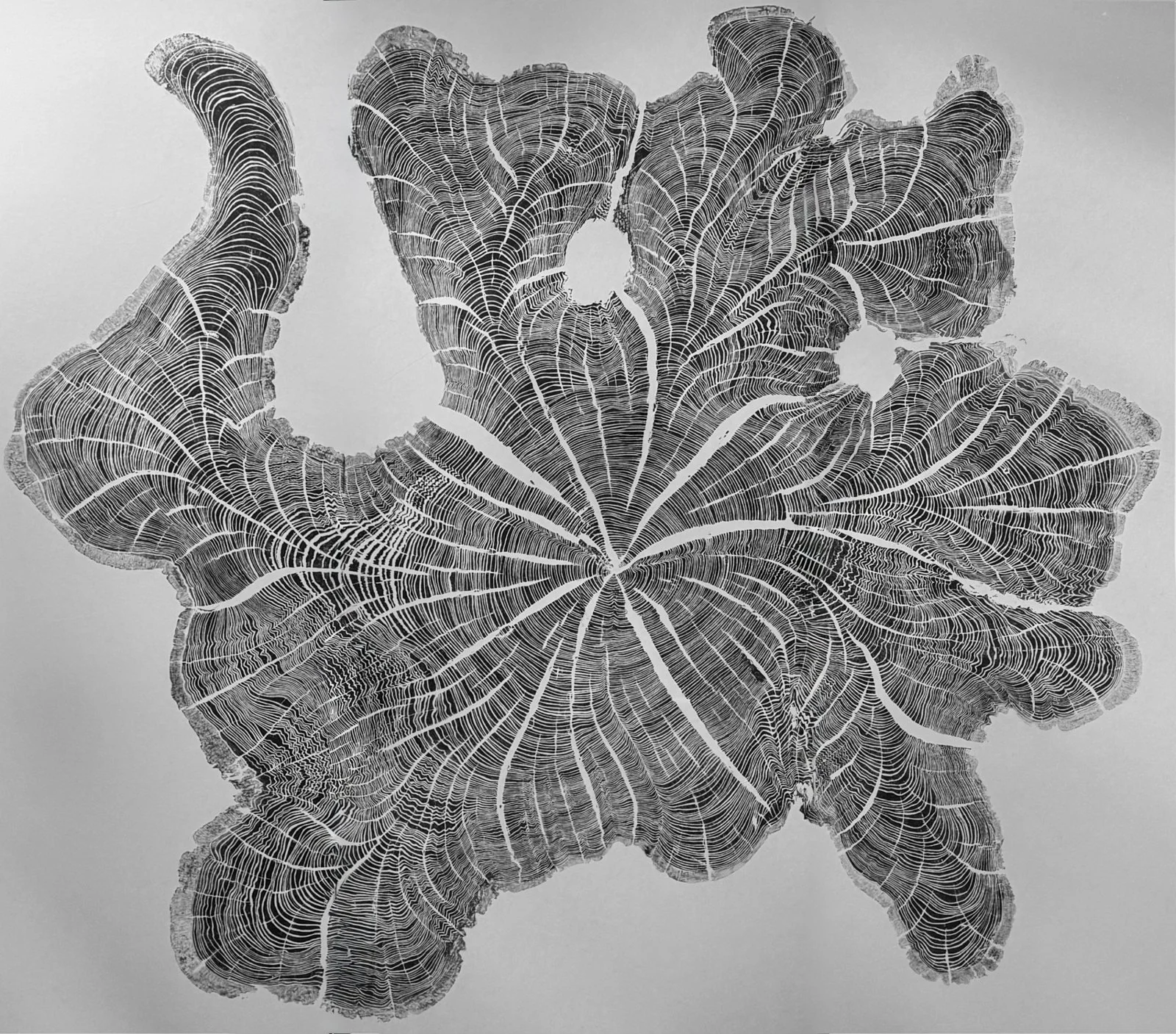
The largest and most physically demanding work Kaulback has created, Heartwood is a large-scale, limited-edition relief print honoring Steinem’s life and legacy. Its title refers to the enduring inner core of a tree: though its cells are no longer living, they continue to give the tree strength. The work draws on that image to reflect how Steinem’s influence carries forward beyond a single lifetime.
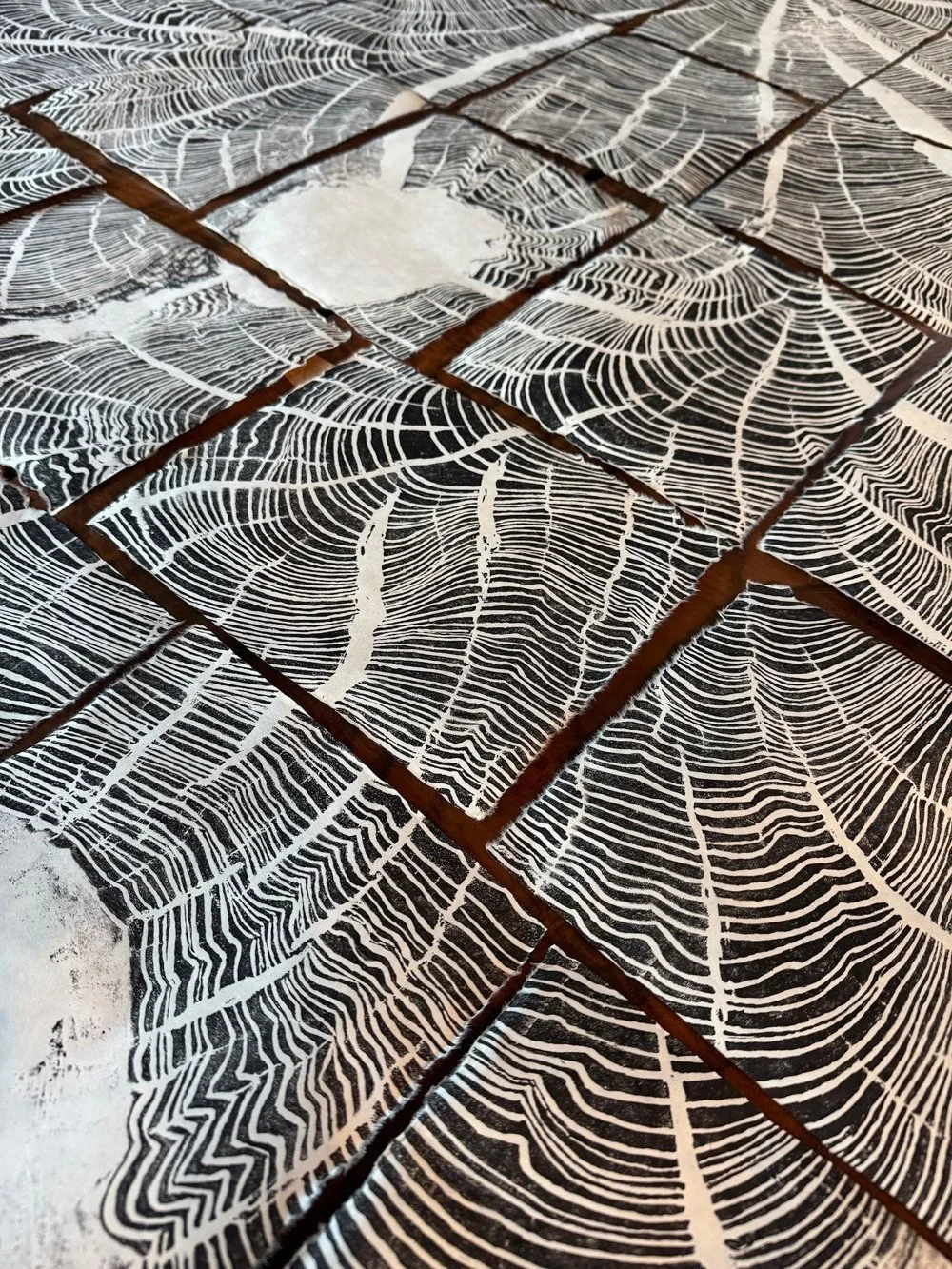
Kaulback spent more than 100 hours carving the printing surface, using sanding, hand-carving, and pyrography to bring out the wood’s grain, growth rings, and textures. Printing on delicate Japanese rice paper required patience and precision. Oil-based ink was then applied and hand-pressed onto the paper, which was then carefully wet-mounted to canvas using the traditional Japanese urauchi method. Kaulback also hand-selected and shaped the Bastogne walnut frames.
Heartwood is a full-scale relief print of the same eucalyptus slab as Shlain’s, presented as a triptych of three panels, each measuring 92 × 38½ inches. The full framed work measures 96 × 120 inches. The edition is limited to ten.
“Creating Heartwood alongside Tiffany and this extraordinary circle of women has been an incredible experience,” Kaulback says. “In just a few short weeks, we brought something meaningful to life through a shared sense of purpose, talent, and determination. These are capable, driven women who make things happen, and I’m as impressed by what we’ve accomplished as I am honored to work alongside them. There’s something fitting about creating a tribute to Gloria Steinem in the company of women who embody that same spirit.”
Through its material, process, and scale, Heartwood becomes a meditation on strength, transformation, and the lasting impact of Steinem’s life on generations to come.
Two sister cross sections
The wood is the sister cut to the eucalyptus Tiffany Shlain and Ken Goldberg used for Tree of Knowledge (2024), made for Getty PST ART: Art & Science Collide, with nearly 200 questions burned into its surface. By chance, Jessica Kaulback had bought this cross section slice from the same tree for her studio long before the project began.
The order matters. A print is a mirror image, so anything written on the wood first would come out backwards. Jessica carved the wood and pulled Heartwood and Heartwood 92 on one side. Then the other side was sanded for Tiffany to burn the words into the wood by hand with pyrography.
See the works
Gloria's Rings was unveiled at the memorial for Gloria Steinem at the Park Avenue Armory on November 18, 2026. Both works are on view until April 30, 2027 at the Living Room at Pier 57 in New York. Open daily, 6 am to 1 am, at 25 11th Avenue.
Gloria's home, kept open
Gloria called the same Upper East Side townhouse home since 1967, and over her many decades of activism, the space became an epicenter for organizing. The first meetings for Ms. magazine happened there, as did planning meetings for farm workers and countless other beginnings. Gloria always intended for her home to remain what it always has been: a gathering place, a respite for artists, and a safe place to work and rest. Gloria established Gloria's Foundation to actualize that vision. The Foundation will secure her home as a lasting site for the feminist movement, ensuring Gloria's archives and this storied space remain a resource for the future, and creating programming that carries the work forward.
Gloria's Rings kicks off a $30 million capital campaign for Gloria's Foundation to preserve Gloria's Upper East Side townhouse as a lasting home for convening and activism.
The artists

Tiffany Shlain
Tiffany Shlain is an interdisciplinary artist, activist, Emmy-nominated filmmaker, nationally bestselling author, and the founder of the Webby Awards. Shlain’s practice spans sculpture, film, writing, and public activation, exploring the intersection of feminism, philosophy, technology, neuroscience, and nature. Shlain’s work has been shown at institutions including the Museum of Modern Art, the Sundance Film Festival, and US embassies globally. Her recent museum exhibition Ancient Wisdom for a Future Ecology: Trees, Time & Technology with Ken Goldberg for the Getty’s PST ART: Art & Science Collide at Skirball Cultural Center in Los Angeles and di Rosa Center for Contemporary Art in San Francisco was highlighted by Artnet as a “Must-See Museum Show.” Her work is included in public and private collections, including the recent acquisition of her 2026 If These Walls Could Talk at the Hotel Chelsea, where she stayed when she was a young filmmaker. Her awards and distinctions include selection by the Albert Einstein Foundation for their Genius100 list, the Neil Postman Award for Career Achievement in Intellectual Activity, and inclusion on NPR’s list of best commencement speeches. Shlain has had multiple premieres at the Sundance Film Festival, received over 65 awards for her films including her documentaries on feminist history Life, Liberty & The Pursuit of Happiness (2003), 50/50 (2016), and her new film Where Are We? (2026). Shlain’s book 24/6: Giving up Screens One Day a Week to Get More Time, Creativity, and Connection received the Marshall McLuhan Outstanding Book Award. She has been writing a monthly newsletter, Breakfast @ Tiffany’s, for 30 years. She is a Henry Crown Fellow of the Aspen Institute and is represented by Nancy Hoffman Gallery in New York.
Jessica Kaulback
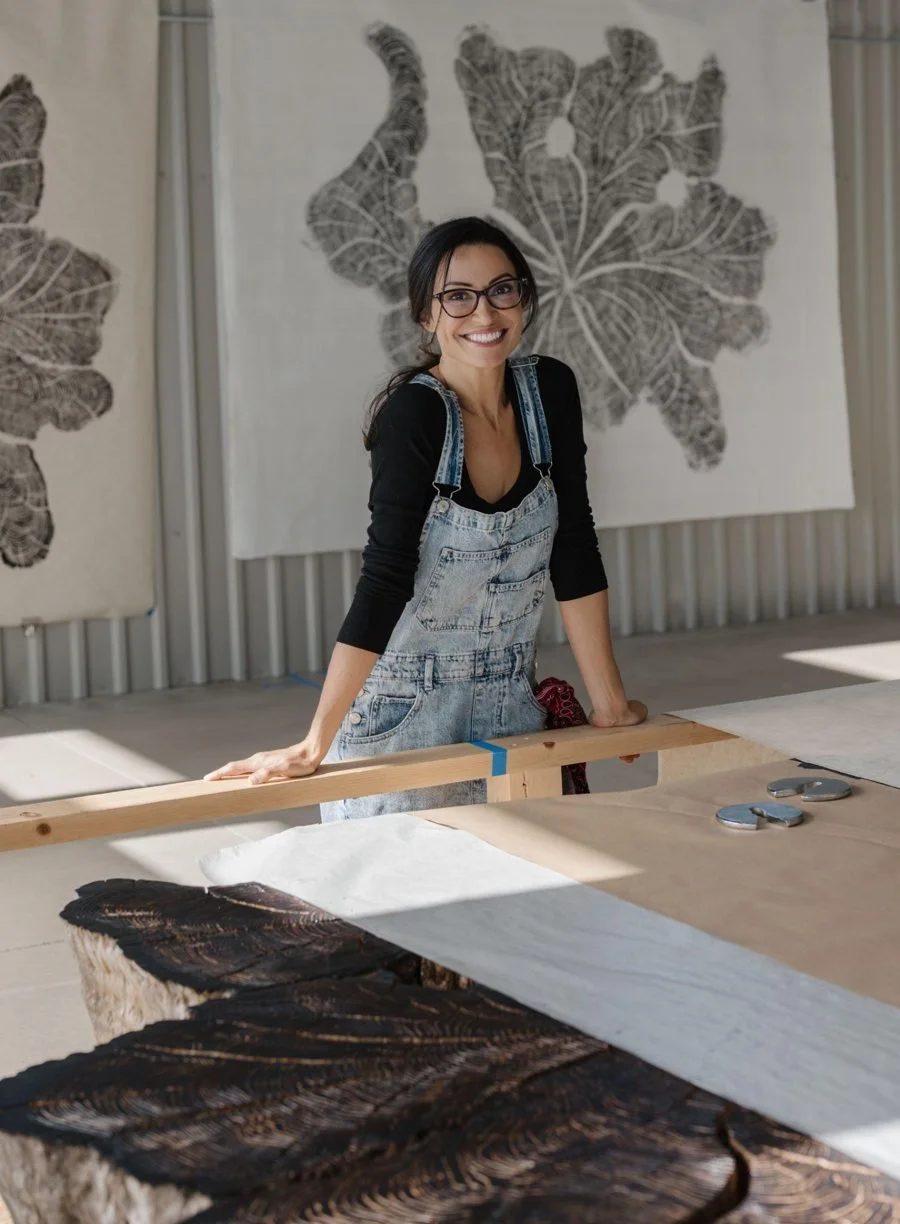
Jessica is a printmaker whose practice spans over a decade of exploration, refinement, and technical mastery in relief printing. Continually exploring new techniques, materials, and styles, Jessica evolves her practice through hands-on experimentation and ongoing education. She is co-founder of KAULBACK Studio in Lake Tahoe, California, where she is developing a showroom for high-end furniture and art set to open in early 2027. Formerly working as Heartwood Ink, she exhibited at the Reno Tahoe International Art Show (RTIA) in 2023 and 2024 and Tahoe Expedition Academy’s Annual Gala in 2025 and was profiled in a multi-page spread in Mountain Gazette, Edition 205. A featured speaker at Truckee-Tahoe female business owner events, Jessica brings a collaborative ethos to her creative practice, valuing quality over excess, empathy over ego, and the collective over the individual. Collaborating primarily with luxury interior designers, Jessica creates original statement pieces for thoughtfully curated large-scale spaces. Her work is currently featured in Tahoe Modern, High Camp Home, Miro Miro, and Craft & Logic.
Join the Effort
Gloria's Rings kicks off a $30 million capital campaign for Gloria's Foundation to preserve Gloria's Upper East Side townhouse as a lasting home for convening and activism.
Gloria's home, kept open
Gloria called the same Upper East Side townhouse home from 1967 onward. Over the decades, it became an epicenter of activism and organizing. The first meetings for Ms. magazine took place there, along with planning sessions for farm workers and countless other efforts. Gloria always intended for her home to remain what it had always been: a gathering place, a respite for artists, and a safe place to work and rest. Gloria established Gloria's Foundation to actualize that vision. The Foundation will secure her home as a lasting site for the feminist movement, ensuring Gloria's archives and this storied space remain a resource for the future and creating programming that carries the work forward.
Collect a framed photograph of A Dendrobiography of Gloria Steinem
Proceeds from 10 framed photographic prints of A Dendrobiography of Gloria Steinem are going to Gloria’s Foundation generously donated by the artist and Nancy Hoffman Gallery in Chelsea, New York.
Artist and Nancy Hoffman Gallery will donate the sculpture to a permanent institution.
Collect a photographCollect a Heartwood original
Of the 10 original Heartwood prints, one has been generously donated to Gloria Steinem’s brownstone. Another has been transformed into 92 framed 8 x 10 inch pieces, each individually signed and numbered and symbolizing a year of Gloria’s life. Alongside these one-of-a-kind works, the remaining eight full-scale original framed triptychs are also available for purchase. Artist will donate the original Heartwood print to Gloria’s Foundation where it will live in perpetuity in Gloria’s brownstone.
Collect HeartwoodTALKING CIRCLES
What is a Talking Circle?
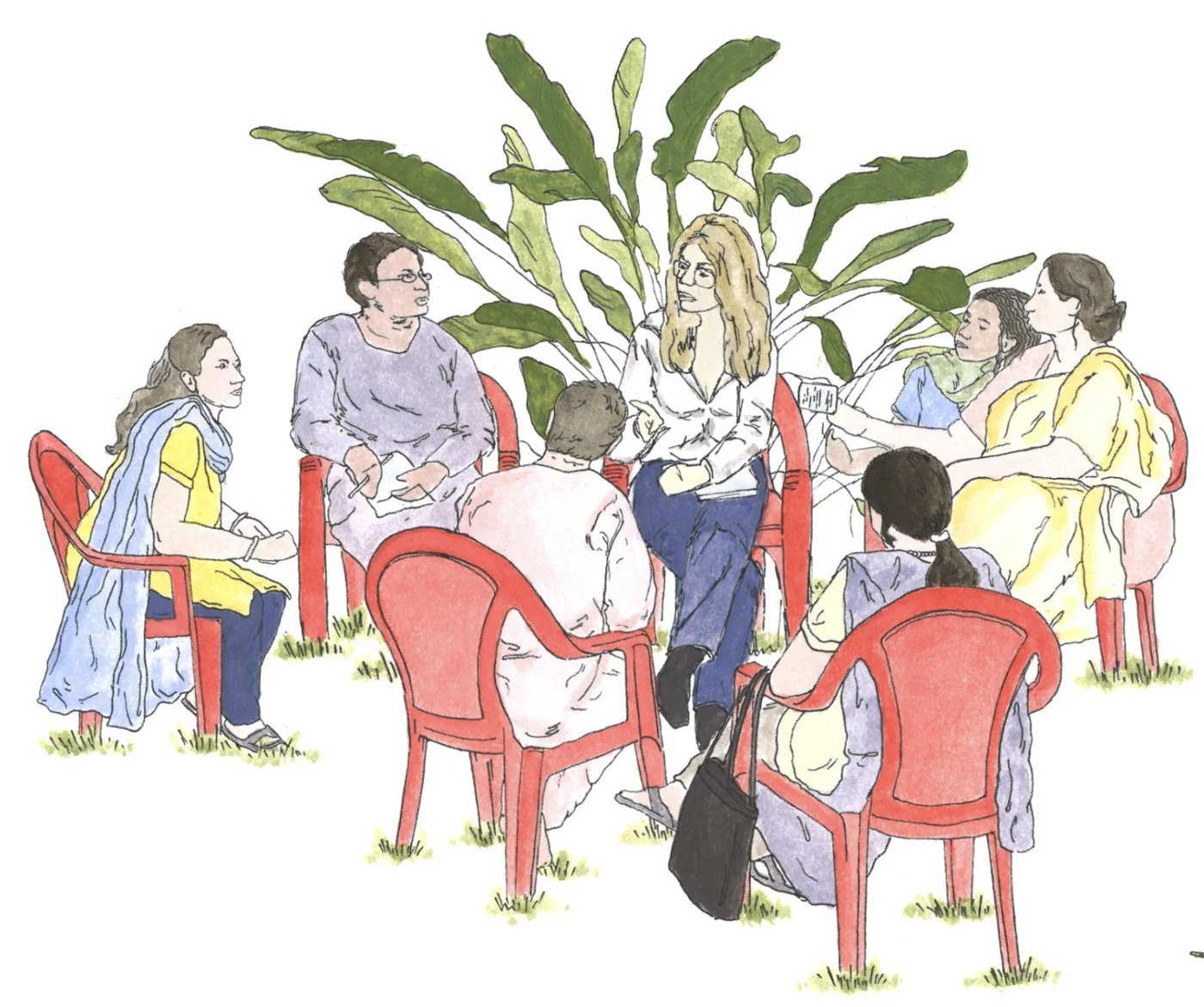
“Groups that are small enough for everyone to speak, everyone to listen, isolation to be overcome, and consciousness to begin to change.” — Gloria
Gloria first learned about Talking Circles in India. The Gandhians in that ashram taught her:
- If you want people to listen to you, you have to listen to them.
- If you hope people will change how they live, you have to know how they live.
- If you want people to see you, you have to sit down with them eye-to-eye.
- If you do something the people care about, the people will look after you.
She then followed that tradition from the “testifying” in Black churches that gave birth to the civil rights movement to consciousness-raising groups that became the source of a movement for female liberation.
Since 1967, her home has provided a backdrop to movements and organizations from birthing Ms. magazine and Women Moving Millions to hosting dozens of organizations and activists far and wide.
Gloria established Gloria’s Foundation to continue that tradition. As she said: “If time and ingenuity allow, I hope to acquire the other floors in this house and leave the whole building as a refuge for diverse women who need a place to stay or just a place to meet.”
In 2026 alone, Gloria’s Foundation has offered over 50 convenings to date, welcoming over 1,000 guests into the transformative space. These gatherings continue fostering meaningful dialogue and opportunity for interdisciplinary organizing. Topics have included women & sports, climate, Black maternal healthcare, mental health, disability justice, journalism, and many more.
Please join us!
www.gloriasfoundation.org
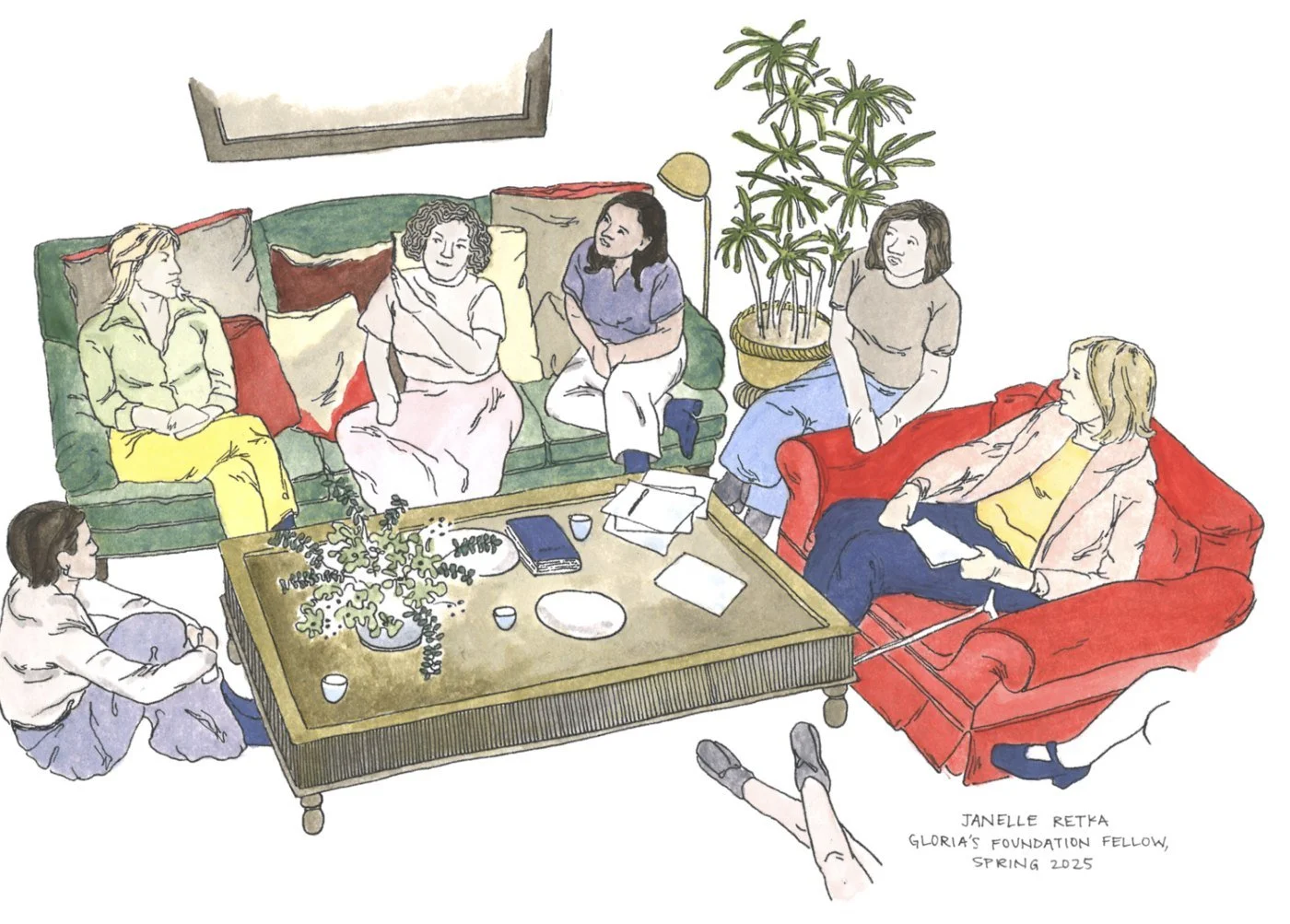
Illustrations courtesy of Gloria's Foundation.
The team behind Gloria's Rings
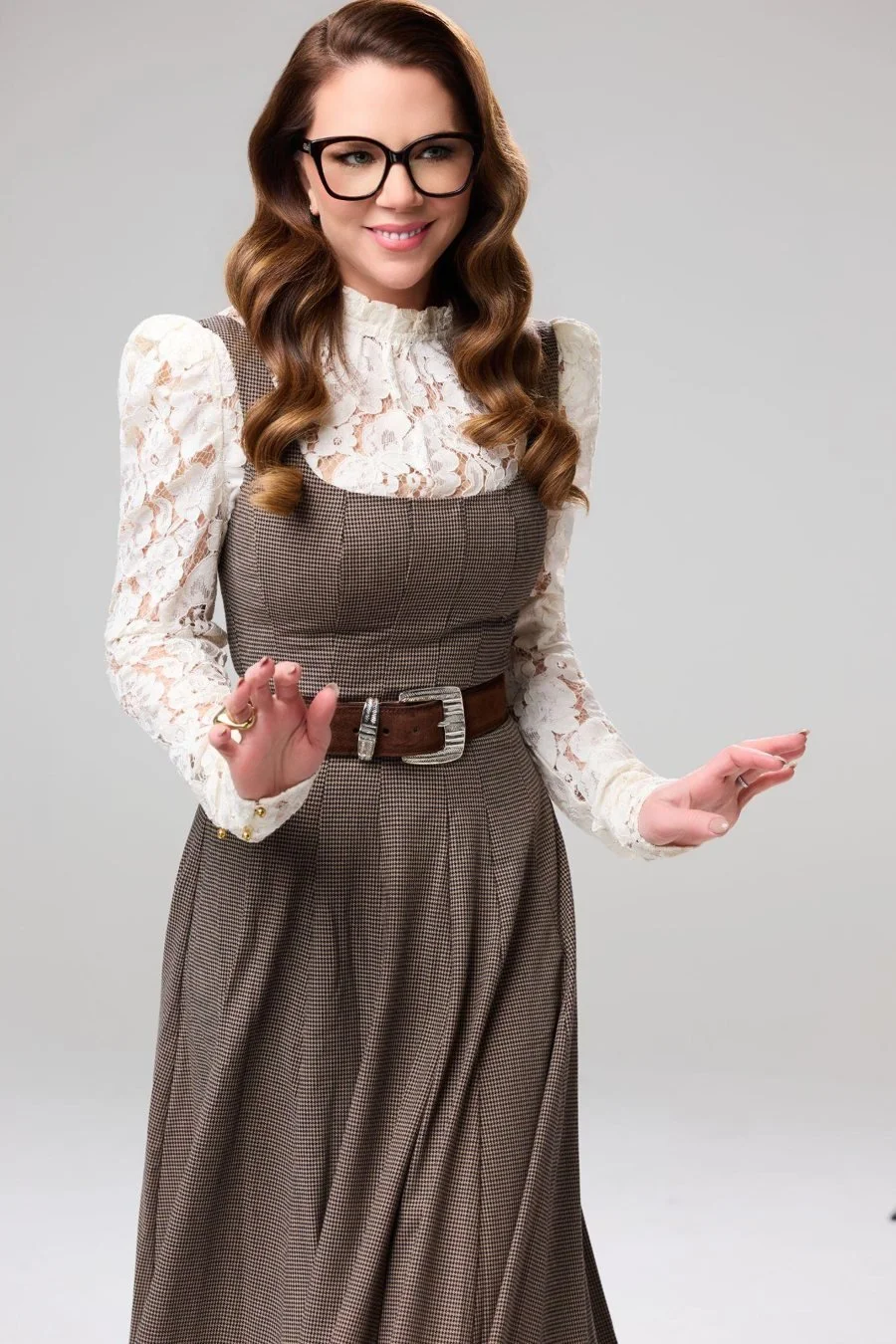
Amy Dornbusch, conceived and commissioned Gloria's Rings
Dornbusch conceived Gloria's Rings to honor Gloria Steinem with art that keeps funding Gloria's Foundation. In a matter of weeks, she assembled the artists, funding and logistics to bring it to life, underwriting the first phase herself and rallying women philanthropists to exceed the match. Known for rapid, risk-tolerant, first-in funding, she builds what she calls philanthropic SWAT teams. She mobilized funding to help evacuate over a thousand Afghan women leaders during the fall of Kabul and mobilized the launch of Paris Hilton's Los Angeles fire relief fund, which raised more than $2 million. In the past decade, she has raised upward of $75 million for causes spanning human and planetary health. An art collector, Dornbusch has hosted a talking circle in Gloria's home benefiting the Foundation. She has spoken at Davos and the Skoll World Forum, been featured in Ms. magazine and Forbes, and appeared on the cover of San Francisco Magazine's philanthropy issue.

Heather Marx, producer
Heather Marx is an arts professional with over 25 years of experience acquiring, curating, and exhibiting work by emerging and established U.S. and international artists. She has curated 150+ exhibitions and produced 50+ commissions for private and institutional clients. Marx is Art Advisor to the Chan Zuckerberg Initiative, curated the Public Art Program at Elco Yards in downtown Redwood City, CA, co-founded San Francisco's Marx & Zavattero gallery (2001–2013), and founded Heather Marx Art Advisory.
ABOUT GLORIA’S FOUNDATION
Gloria’s Foundation is dedicated to preserving Gloria Steinem’s legacy and nurturing the feminist movement. Gloria's longtime wish was that her home remain a vibrant center for organizing. The Foundation is working to secure her Upper East Side home in Manhattan, where Ms. magazine and other organizations were born. Her home remains a place for organizing and activism, including hosting Talking Circles and the Gloria’s Foundation Fellowships. A Home for a Movement is preserving and digitizing her archives. Created in 2015, the Foundation is tasked with bringing to fruition Gloria’s goals. gloriasfoundation.org.
ABOUT LET IT RIPPLE
Let it Ripple is a 501(c)(3) social profit founded by Tiffany Shlain and Sawyer Steele in 2013 to create films, art, events and discussion materials that inspire important conversations about society. Renowned for global art activations, award-winning films, and engaging live and virtual experiences, Let It Ripple's films have been viewed more than 50 million times, have earned 65+ awards, and are showcased in theaters, on television, and on nearly all streaming platforms. They’ve premiered at MoMA, Sundance, and TED and have been featured by the U.S. State Department at embassies worldwide. Gloria’s Rings art works and the short film being made about the project in relation to Gloria Steinem’s legacy is a project of Let it Ripple. letitripple.org and
Selected text from Gloria's 92 years
Tiffany Shlain researched Gloria Steinem’s life and distilled it into 92 texts representing her 92 years. She then burned these markers into the wood. The final sculpture reads like a clock: a line runs from the center of the tree, the “heartwood,” to the branches, each branch holding a decade or two of her life. Two hollow knots frame the timeline. Shlain sees them as portals, one for Gloria’s birth into existence and one for her passing back into everything. You are invited to read every marker below.
This timeline is only available on this website for the guests of Gloria’s memorial. After Nov 18th, please visit the sculpture, which will be on display at Pier 57 along with Heartwood until the end of April, 2027.
The 1930sMarkers 1–2
March 25, 1934
Gloria Steinem was born in Toledo, Ohio to Ruth Nuneviller, a former reporter and editor who wrote under a male pen name (Duncan McKenzie), and Leo Steinem, a traveling antiques dealer and entrepreneur. “My father was the Jewish half of the family, yet it was my mother who taught me to have pride in that tradition.”
1930s–1940s
Her family traveled around the country in a trailer and operated a summer dance pavilion in Michigan where Duke Ellington and The Andrews Sisters performed. The family's lifestyle kept her from regular school attendance, and she recalled learning to read from street signs. “I was conditioned early to live in an on-the-road state of mind…being open to whatever we find when we leave our door.”
The 1940sMarkers 3–7
1940s
"My favorite book, as a child, was Little Women. It was the first time I realized women could be taken seriously on their own.”
1944
After parents separated, became a caregiver for her mother, who experienced a serious mental break that Gloria thought was worsened by leaving her career to raise a family. “My mother paid a high price for caring so much, yet being able to do so little about it. In this way, she led me toward an activist place where she herself could never go.”
Around 1946
Began attending school full-time, not knowing any math or science. "I didn't go to school a full year until I was 11 or 12, so I lived in books. I really was an observer of life."
1946
Attended Girl Scout camp in Michigan. "We all have a place at the campfire. It was Girl Scouts who first taught me that.”
1948–51
Attended high school in Toledo, Ohio and worked briefly as a magician’s assistant.
The 1950sMarkers 8–12
1952
Graduated from high school in Washington, D.C., while living with her older sister Susanne Patch.
1953–54
Worked as a lifeguard and swimming instructor in a primarily Black neighborhood. She would later declare, “I learned feminism disproportionately from Black women.”
1952–56
Studied government at Smith College where she met longtime friend Phyllis Rosser and spent a summer studying at Oxford, graduating magna cum laude as a member of Phi Beta Kappa.
1957
A physician in London, Dr. John Sharpe, helped her access an abortion at age 22 before she traveled to India. Sharpe asked her to promise to do what she wanted with her life.
1957–58
A fellowship supported two years in India, where she wrote for Indian publications and learned from Gandhian activism. “I fell in love with India, a country whose ancient diversity and modern rebellion against colonialism I loved. There, I also discovered that what I thought was the Gandhian movement, was really a women’s movement.”
The 1960sMarkers 13–29
1960
At age 26, joined the staff of the satirical magazine Help! from MAD magazine founder Harvey Kurtzman. She later wrote, "Laughter is an orgasm of the mind."
1960
FDA approved birth control pill in the United States. She later said, “When The Pill came along women were able to give birth to ourselves.”
Early 1960s
Her journalism assignments included subjects such as nylon stockings. “I was disappointed that this was what I was stuck with, but I researched the hell out of textured stockings!” She recalled a Life editor rejecting her because he assumed a pretty woman could not be a serious writer.
1960s
Met John Kenneth Galbraith and Clay Felker, who would become her mentors and friends. She described Clay as “a walking test for ideas.”
1962
Published her first major article in Esquire about the birth control revolution and the ways it was transforming women’s lives.
1963
Went undercover as a Playboy Bunny named “Marie Catherine Ochs” to investigate working conditions, publishing the resulting exposé as “A Bunny’s Tale.”
1965
Nominated for an Emmy for her writing for the television satire sketch comedy program That Was the Week That Was. “Writing is the only thing that, when I do it, I don’t feel I should be doing something else.”
1965
Convinced then-boyfriend Mike Nichols to film Who’s Afraid of Virginia Woolf at Smith College.
1966
"I love clothes, and I am getting over feeling guilty about it. They make me feel better, look better, etc. The whole thing just has to be in perspective."
1967
Began renting the brownstone she would later buy, living with artist and friend Barbara Nessim.
1968
Met her lifelong friend and future Ms. colleague Alice Walker.
1968
Began hosting talking circles, a practice she learned in India, a hierarchy-free discussion format that would evolve into consciousness-raising groups.
1968
Helped launch New York magazine with friends and mentors Clay Felker and Milton Glaser and recruited Stephen Sondheim to create crossword puzzles for the magazine.
1968
Worked on George McGovern’s campaign, including fundraising and speechwriting, growing disillusioned when a top advisor barred her from a meeting by saying “no broads.” “I think of these as moments of revelation that get you off your ass and into the revolution.”
1969
Reporting on an abortion speak-out helped crystallize her feminist activism. She later wrote, “Whether or not women can decide when and if to have children is the biggest determinant of our health, our education, our ability to work outside the home, and how long we live.”
1969
Met longtime friend and ally Dorothy Pitman Hughes when she interviewed her for New York magazine. She described her as “absolutely fearless” and her “partner in the struggle for women’s rights.” Speaking in public alongside Dorothy helped Gloria gain confidence. "I discovered that you didn't die, and that something happened when you were speaking in a room that could not happen on the printed page.”
1969–70
Rose to national prominence in what would later be called the second wave of the feminist movement with essays like "After Black Power, Women's Liberation" and her testimony for the Equal Rights Amendment in 1970.
The 1970sMarkers 30–49
1970
Served as national treasurer for the Angela Davis Defense Fund.
1970
In her commencement address at Vassar College, she said, “The first problem for all of us… is not to learn, but to unlearn.”
1970s
Became the godmother of Alice Walker’s daughter Rebecca, who would become a co-founder of third-wave feminism.
1971
Co-founded the National Women’s Political Caucus, alongside Betty Friedan, Shirley Chisholm, Fannie Lou Hamer and Bella Abzug. In her address, she declared: “This is no simple reform. It really is a revolution.”
1971
In Boston, an older Irish female cab driver told her and Florynce Kennedy, “If men could get pregnant, abortion would be a sacrament,” a line the two would share in later speeches.
Around 1971
She initially imagined Ms. as a newsletter. Brenda Feigen-Fasteau encouraged her to pursue a magazine instead. She and her colleagues spent roughly a year seeking investors. Publisher Katharine Graham contributed $20,000 toward expenses.
1971
Ms. debuted as an insert in New York magazine. Its test issue sold 300,000 copies in eight days. Its inaugural material included 53 women acknowledging their abortions, before Roe v. Wade.
1972
Wonder Woman was chosen for the first regular issue’s cover, in part to protest DC Comics’ decision to remove Wonder Woman’s superpowers. Gloria would serve as editor for the next fifteen years, working alongside co-founders and collaborators including Patricia Carbine, Joanne Edgar, Nina Finkelstein, Suzanne Braun Levine, Mary Peacock, Letty Cottin Pogrebin, Margaret Sloan-Hunter, and Mary Thom.
1972
Passage of Title IX prohibiting gender-based discrimination in US federally funded educational programs and activities. Gloria would later write, “What your body can do is way more important than how it looks.”
1972
The US Senate approved amending the Equal Rights Amendment to the Constitution, which would finally give women equal rights in America. It was ratified in 2020, but as of 2026, not yet published.
1972
Became the first woman to speak at the National Press Club. She later wrote, “Women have to learn how to talk as much as we listen. Men have to learn how to listen as much as they talk.”
1973
Roe v. Wade legalized abortion in all US states and territories. Gloria would later write, “As long as females are valued only for our wombs, we will never be valued for our minds and hearts.”
1973
Established Ms. Foundation for Women with Patricia Carbine, Letty Cottin Pogrebin, and Marlo Thomas.
Early 1970s
Met longtime friend Ruth Bader Ginsburg when Ginsburg sent her to Mississippi on behalf of the ACLU to interview women who had been sterilized without consent, including Fannie Lou Hamer.
1974
Equal Credit Opportunity Act allowed women to open a credit card account without a male co-signer. “Nothing changes the gender equation more significantly than women’s economic freedom."
1974
When told she did not look forty, she replied: “This is what forty looks like. We’ve been lying so long, who would know?” (She also said this when she turned fifty.)
1976
Along with E. M. Broner, Letty Cottin Pogrebin, and Phyllis Chesler, she began hosting an annual women’s Passover seder using a feminist Haggadah. “The women’s seder introduced me to ritual. It was the first spiritually-centered occasion in my feminist life. When I feel most drawn to Judaism, it’s not the law part that attracts me, it’s the mystical part, the Kabbalah, the Shechinah. I do feel socially drawn to Jewish warmth, sensuality, expressiveness.”
1978
Her satire “If Men Could Menstruate” imagined menstruation becoming prestigious if men experienced it.
1979
Co-founded Voters for Choice. "The voting booth is the one place on earth where the least powerful and the most powerful are equal."
1970s–80s
Participated in anti-war and nuclear freeze movements, later writing, “The only form of arms control is how we raise our children.”
The 1980sMarkers 50–57
1980
9 to 5 released. The film was based on a 1977 Ms. cover story. She would later write, “People who haven't listened to Dolly Parton or to feminism may be surprised to learn that they go together.”
1983
“Women have always been an equal part of the past; just not an equal part of history.”
1983
Published Outrageous Acts and Everyday Rebellions, including her tribute to her mother, “Ruth’s Song (Because She Could Not Sing It),” and the declaration, “A feminist is anyone who recognizes the equality and full humanity of women and men.”
1984
She revealed that she liked to tap dance alone in elevators and also described taking tap-dancing breaks from her typewriter. "If there’s no dancing at the revolution, I’m not coming."
1984
Arrested outside the South African Embassy in Washington, protesting apartheid, a year after writing “Women grow more radical with age.”
1986
Published a book about Marilyn Monroe, writing, “Marilyn was just an exaggerated version of what women were supposed to be.”
1986
New York Times finally adopted the use of the title “Ms.,” a change Gloria had called for since 1973, writing executive editor A.M. Rosenthal, “It isn’t possible to continue forcing women to disclose marital status when men are not forced to do the same.”
1989
Kimberlé Crenshaw, who would become Gloria’s ally, defined the concept of intersectionality and helped usher in third-wave feminism.
The 1990sMarkers 58–63
1990s
Helped establish Equality Now, an international women’s rights organization and Take Our Daughters to Work Day, created by Ms. Foundation for Women. “Your daughters are watching you.”
1991
Met Amy Richards. “I just had to wait for some of my friends to be born.”
1993
“Dreaming, after all, is a form of planning.”
1994
The Violence Against Women Act, written and championed by Victoria Nourse, Esta Soler, Patricia Schroeder, Louise Slaughter, Barbara Boxer, and Pat Reuss, was signed into law, 11 years after Gloria wrote, “Invading bodies is still less punished than invading property.”
1995
"God may be in the details, but the goddess is in the questions."
1997
Took the first of what would be many trips to Africa, where she worked to end apartheid and support girls’ education and women-run collectives. “Growth comes from saying yes to the unknown.”
The 2000sMarkers 64–72
2000
Gloria called close friend Wilma Mankiller, the first woman Principal Chief of the Cherokee Nation, to ask if she should marry David Bale at age 66. “I hadn’t changed—marriage had changed.” Wilma told her she would go sit under a tree to think about it. The next morning, Wilma called back and simply said, "Yes,” later serving as officiant. Gloria and David referred to each other as “the friend I married.”
2002
“Imagine your future self walking on the path ahead of you, let her lead you.”
2003
David Bale died with Gloria at his side. She later described her grief: “In depression you care about nothing. In sadness you care about everything.”
2003
Take Our Daughters to Work Day was expanded to include sons. “We always envision that the equal or other half of this was ‘Take Our Sons Home Day,’ since they have been equally deprived of exposure to what work the home requires,” Gloria said. “Many people have begun to raise daughters more like our sons, but too few people raise sons more like daughters.”
2005
From Jewish Women’s Archive CEO Judith Rosenbaum, Gloria learned about her suffragist grandmother Pauline Perlmutter Steinem, who was a leader in the National American Woman Suffrage Association, attended the 1908 International Council of Women, and was instrumental in helping family members escape from Nazi Germany. “I remember my grandmother for her own courage, but also as an example of the ways women's history can be lost, even in our own families.”
2005
Co-founded the Women’s Media Center with Jane Fonda and Robin Morgan. She later wrote an essay for the center titled “Mother as a Verb.”
2006
Tarana Burke started the #MeToo movement. She and Gloria would go on to become friends and allies.
2008
Campaigned for Hillary Clinton, writing in an op-ed, “There is still no ‘right’ way to be a woman in public power without being considered a you-know-what.”
2009
Passage of the Lilly Ledbetter Fair Pay Act. “If you say, I'm for equal pay, that's a reform. But if you say, I'm a feminist, that's a transformation of society."
The 2010sMarkers 73–86
2011
“Feminism starts out being the instinct of the little child who says ‘It's not fair,’ and ‘You are not the boss of me,’ and it ends up being a worldview that questions hierarchy altogether."
2011
“I know that there’s a feeling that we’re fighting the same battle over and over again, but this is the battle: if we weren’t the means of reproduction…we wouldn’t be in this jam. And in fact, for 95 percent of human history women controlled their own fertility,” through timing, herbs, and abortifacients, “and decided when and whether to have children.”
2013
At the African Grandmothers Tribunal, Gloria said, “We are linked, not ranked,” reflecting her philosophy of interconnected circles instead of hierarchical pyramids.
2013
President Obama awarded her the Presidential Medal of Freedom.
2014
Celebrated her 80th birthday among rescued elephants in Botswana. "Elephants are nonviolent, they're matrilineal, vegetarian, they have a sense of humor, long memories— if only we could all be a little more like elephants."
2015
Dedicated My Life on the Road to Dr. John Sharpe. “When people ask me why I still have hope and energy after all these years, I always say: Because I travel.”
2016
“I will always be an 18- or 19- or 20-year-old person.”
2016
Presidential candidate Hillary Clinton won the popular vote. Ten years later, Gloria wrote, “We live in a democracy that’s one of the few in the world that’s never had a female elected leader. That’s kind of ridiculous. I mean, we’re choosing from half the country’s talent.”
2017
Speaking at the Women’s March, she said, “Our Constitution doesn’t begin with, ‘I, the President,’ it begins with, ‘We, the People.’”
2017
Rutgers created an endowed chair in Gloria’s name devoted to media, culture, and feminist studies.
2019
“You’re going to make mistakes and you will learn from them. Say you’re sorry, ask what you could have done better, learn—and move on.”
2019
Published The Truth Will Set You Free, But First It Will Piss You Off! "To write is to bring an inner voice into the outer world, to believe that our thoughts are worth entering the thinking of others, and to make real what has never existed in quite the same way before.”
2019
Arrested alongside Jane Fonda at a #FireDrillFriday climate protest in Washington, D.C. “The biggest cause of global warming is forcing women to have children they don't want to have."
2010s–20s
Advocated for paid parental leave for fathers as well as mothers. “Women are not going to be equal outside the home until men are equal in it.”
The 2020sMarkers 87–92
2020
“The virus knows that race, gender, class and national boundaries are all fictions. This could help us realise we are all passengers on Spaceship Earth.”
2021
On International Women’s Day, Gloria wrote, "Change is slow. Like a tree, it grows from the bottom up, and we still have a long way to go. But we just need to keep going and to celebrate how far we’ve come."
2022
Dobbs ruling allowed abortion to be outlawed or restricted in some states. “Without the right of women and men to make decisions about our own bodies, there is no democracy.”
2025
“The purpose of friends is to understand and be understood.”
March 25, 2026
“I love it here in this world, and I want to stay as long as possible.” On her 92nd birthday, her memoir An Unexpected Life was announced. She ended the first chapter, “being remembered with love is the best form of immortality.”
September 2, 2026
Gloria Steinem died at age 92 surrounded by some of the many who loved her.
“People now ask me if I'm passing the torch. I always explain that no, I'm keeping my torch, thank you very much… And I'm using it to light the torches of others…We each need a torch if we are to see where we're going. And together, we create so much more light.”
Gloria Steinem